Introduction:
In recent times, the African Union (AU), through its member-states are flexing sinews by making statements on economics, politics and social challenges which adversely affect their countries and peoples at the United Nations (UN). While the UN offers its member-states and the international community platform to engage, deliberate and proffer solutions to resolve global issues, its influence and clout are wanning because some powerful countries, especially the USA under President Trump, have devised strategies to weaken the institution. To protect the unique interests and welfare of their peoples, other continents such as Asia and Europe have strengthened their regional capacity to stem intra and interstate conflicts without soliciting external help. However, the AU, after its inception and initial achievements, has misdirected its vision and objectives of promoting regional growth and prevention of conflicts to support the socioeconomic welfare of the people and continent. One example of such failure is the AU’s inability to resolve the Somaliland and other conflicts which have created opportunities for developed countries to meddle in African politics, thus rendering the continent porous to manipulation by external forces. With that characterisation, this blogpost first offers an overview of Somaliland; second, it examines the role of the Political Affairs, Peace and Security (PAPS) organ of the AU; and third, propose some strategies to help the AU assert its relevance in global affairs of the 21st century and beyond.
Somaliland
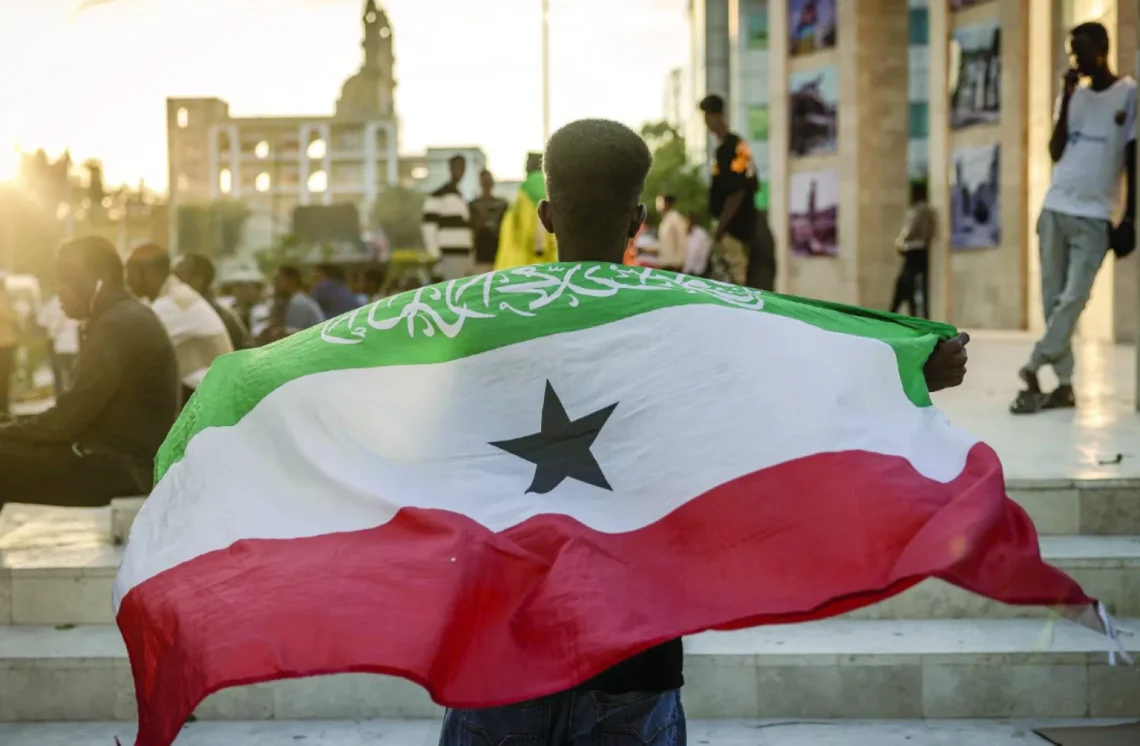
Somaliland, which is/was part of Somalia is in the horn of the African region. It has hundreds of miles of coastline along the Gulf of Aden to the North. It borders Ethiopia to the south and west and Djibouti to the northwest. According to the Worldometer, it has a population size of 4.3 million people as at 2024, occupying an area of 176.119 square kilometres (about the size of Missouri in the USA). Historically, Somaliland was a district region of Somalia in the 19th Century and later became a protectorate of the British until 1960 when it unified with the present -day Somalia under Italian rule; however, power was centralised in the south of the country; but the leadership maltreated the Somalilanders for many years. Consequently, a rebel group -the Somali National Movement (SNM) – emerged in the1980s to oppose the military junta of President Siad Barre, who seized power in 1969 and fomented pervasive inter-and-intra tribal conflicts, distorting the socioeconomic and cultural wellbeing of the people. Thus, in 1991, the SNM together with other rebel groups fought to oust President Barre whose forces had killed thousands of Somalilanders and destroyed majority of the region’s infrastructural and social facilities. Incensed by the atrocious behaviour of Barre’s forces, the Somalilanders rejected an interim government and in May 1991 declared its independence with the city of Hargeisa as its capital. Although politically the region had declared itself independent from Somalia in 1991, the AU and the international community had not officially recognised its independent status yet. Somaliland has elected presidents, legislative assembly, and appointed judiciary to function a separate country. Without regional or international recognition, it has held democratic elections since 2003 where the US, France, UK including the EU, have sent delegations to observe its presidential elections; and in 2017, Somaliland elected an opposition party leader called Waddani as president in a peaceful election. The policy by the governments of France, UK, EU and the US of sending delegations to observe and approve presidential elections of Somaliland since 2017 without recognising its independent status as a separate country of Somalia, reflects a hypocritical stand of those western states while projecting the AU as a white elephant.
The Cluelessness of the AU in Conflict Resolutions
Globally, there are raging conflicts dotting every region of the world. While the Asian, American, and European regions have concrete and substantive strategies to stem their conflicts, the AU remains clueless because of the following factors. First, there is a lack of strong selfless-leadership to devise strategic policies to promote human-centered governance that promotes the social welfare of the citizenry, coupled with respect for social cohesion. By cursory analysis, conflicts in African states are motivated by bad governance where those in politics amass welfare at the expense of the people; suppression of individual freedom through tribal and racial discriminatory practices; absence of socioeconomic safety nets to support the poor and weak in society and endemic corruption among public servants who flaunt wealth to the chagrin of the suffering masses and many more known factors. While African leaders are prone to forming state organs at domestic and at the AU levels to stem crises facing the continent, majority of these organs exist nominally without substantive planning, resources, and manpower to resolve the identified challenges. For example, the Somaliland debacle has existed and persisted since the 1990s, yet there has been little active attempt by the AU to resolve the crises peacefully. This failure, including others, which mirror the AU as clueless, should be interpreted in one sense. That, the Political Affairs, Peace, and Security (PAPS) of the AU, which is an organ responsible for promoting peace and stability on the continent comprised former and siting presidents who were either liable for engineering domestic or sponsoring inter-state conflicts beyond their states. For example – Bankole Adeoye of Nigeria, Sahle Zewde of Ethiopia, Uhuru Kenyatta of Kenya, and Faure Gnassingbe of Togo. Ridiculously, none of the afore-mentioned political leaders comported themselves incredibly in office to gain the respect of rebels fighting various wars across Africa for economic or political freedom. Also, the membership of the PAPS has no seasoned academic or professional diplomat versed in conflicts resolution and peace-building activities. Is there any wonder the AU remains a nominal organisation in the face of conflict resolution? I hope not. The new awakening among African states to establish economic and political freedom without reliance on external sources requires a stable-visionary leadership, a consciously-awaken-citizenry, and dedicated resources to stem domestic conflicts as a strategy to build a peaceful continent devoid of perennial wars. The AU will only regain part of its former clout when it is able to prevent inter- and- intra state conflicts among its member-states by building a permanent peace resolution organ which is adequately resourced beyond the current PAPS, which is repleted with dysfunctional former and current heads of states. The following recommendations might help the AU in that policy direction.
Recommendations for a New Conflict Strategy
First, the AU must have a visionary leadership who can mobilise the leaderships of the member-states to acquiesce to the founding principles of the Union and show active commitment by contributing financial and man-power resources to re-establish a regional miliary force whose mandate is to promote and protect regional and continental stability. This objective can be achieved by the AU where the respective state leaderships commit to their share of financial obligation as well as entrusting to seasoned military experts versed in conflict management and resolutions without interference by any state. Second, the AU must demonstrate courage in dealing with each intra-and-inter conflict on its unique facts because the argument that recognising the independent status of Somaliland would open the pandora box is a weak proposition. Each case is unique because the South Sudan and Western Saharan agitations for independence are premised on different sets of facts. And failure to confront and deal with them in that respect would generate perennial intra-state conflicts that render the AU as a weak institution, motivating the beleaguered states to solicit external help. By soliciting external help, the western states see an opportunity to influence not only regional affairs but also entrench their presence to make the organisation more redundant. Third, the AU must build a cohort of conflict resolution experts drawn from academics in security and conflict management, diplomats, military service men/women, and African business leaders to form a permanent organ to help broker continental peace.
Final Comments
This post contends that the AU must formulate a strategic policy to resolve the Somaliland and other regional conflicts which not only distort continental socioeconomic and political stability but also help to transform the organisation as competent body capable of steering the development of the peoples. Also, it opines that the AU should consider each case for independence by the agitated states on its own merits and act with courage to prevent western states from infiltrating the continent but cater for the people’s wellbeing. This post concludes that the AU should form a new security organ to draw on a cross-section of expertise from member-states, supported financially and logistically to achieve a stable continent. Without that, the Somaliland debacle would continue to define the AU as a clueless organisation bereft of influence to spur continental growth and freedom.