Introduction:
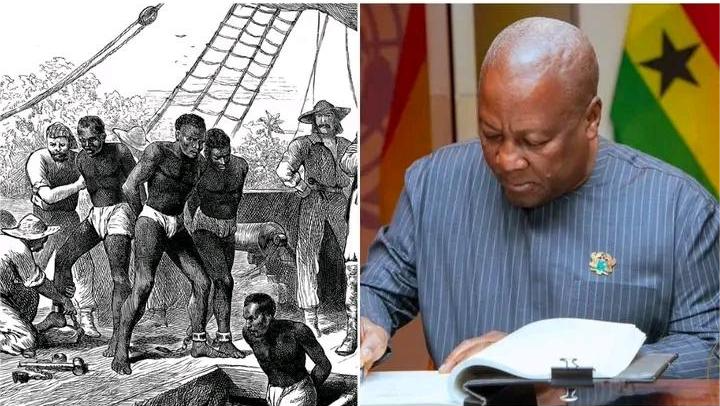
On 25th March 2026, Ghana’s Renaissance President, John Dramai Mahama (JDM), tabled a Resolution at the United Nations General Assembly (UNGA Reso. A/80/48), in New York, demanding that the western states recognise that Slavery and Trans-Atlantic Slave Trade activities perpetrated by their fore-fathers against Africans and peoples of the diaspora as crimes against humanity and consider reparation for same. The Resolution attracted positive support with 123 countries voted in favour, 3 countries voted against and 52 countries abstained from voting. A cross-section of those countries which abstained consisted of Canada, The United Kingdom (UK), France, Finland, Germany, Georgia, Sweden, Switzerland, Austria, Australia, New Zealand, Italy, Luxembourg, Hungary, Netherland and Slovenia among others. The resolution raises legal issue in international law, focusing on slavery and trade.
Slave Trade and Intertemporal Law
Without converting this blog into complex international law lectures, the doctrine of Intertemporal law is affected by the slavery and slave trade debate. The doctrine simply explains that a legal action should be judged by the law in effect at the time an offence or liability is committed. On that premise, no legal action or an obligation can be ascribed to a person or an organisation for partaking or participating in an activity for which there was no law prohibiting that wrong-doing /offence. For example, if A slaps B on 31 March 2026 and on that day there was no law characterising the slap on B as an offence, but on 1 April 2026, a law has been passed/enacted, stating that slapping any person without attack or provocation is an offence attracting punishment, B who was slapped on 31 March 2026 cannot now go to court to seek redress. This is because in international law the law cannot function retroactively. The principle of retroactivity forbids/prohibits reversing backwards in time or history to impute guilt or wrong-doing to actions/deeds for which no law exists at the time of committing the act. Thus, viewed through the lens of the principle of retroactivity, slave trade and slavery activities, which were not criminal acts during those years when they were committed against Africans and the peoples of the Caribbeans, cannot be litigated or challenged for reparation in 2026 when slave trade and slavery are globally recognised as criminal acts and crimes against humanity. Simply, in international law, no crimes were committed against the Africans and all those affected by slavery. This is the context in which the recent African Res A/80/L48 is examined, indicating that though Res A/80/48 will attract some publicity by renewing political debates in some African countries; however, substantively nothing significant nor will the proposed reparation be materialised because UNGA resolutions are unenforceable. One caveat worth stating here is that this blog is not against the African and Caribbean peoples’ attempt to secure reparation, but simply discussing the topic from the perspective of international law researcher.
Efficacy of UNGA Resolutions and the Mahama’s Reso A/80 in International Law
Like many UNGA resolutions, this Mahama’s Reso. A/80 attracted sharp and scathing condemnations from key states in the Northen hemisphere arguing brazenly that they do not owe African states any reparations because slavery was not a criminal act at the time those wrongful acts were committed. The US representative at the UNGA described Reso. A/80 as highly “problematic further stating that it does not require a legal right to secure reparations for historical wrongs.” The European Union (EU) also criticised the resolution stating that “suggestions of a retroactive application of international rules which were non-existent at the time and claims for reparations, which is incompatible with established principles of international law is absurd.” The United Kingdom (UK) further argued that “there was no prohibition on slave trade and slavery related activities at the time.” Plainly, the core argument of those western states who were steeply involved in the crimes of slave trade and slavery, denied the wrong-doing through the prism of intertemporal law. This is the position of the western countries and other powerful nations who abstained during the voting. The message is that; we owe African and Caribbean countries nothing. Restraining from legal scholarship on the topic, this blog explains two characteristics of UNGA resolutions below.
First, it should be noted that UNGA resolutions are not binding, meaning that they cannot be enforced against a member-state or organisation because they are framed in hortatory language. Hortatory, according to the Cambridge English Dictionary, means “trying to strongly encourage or persuade someone to do something.” Since UNGA resolutions are framed in hortatory language to encourage without possessing binding effect, member states who fail to abide by them do not get punished or face legal sanctions. These traits of UNGA resolutions have been criticised in academic, practitioner and diplomatic circles as weaknesses of the United Nations (UN) regime. Second, UNGA resolution is characterised by the principles of “good faith” which is at the core of law enactment and negotiation activities. “Good faith in legal/law provinces requires open and honesty in dealing with one another as well as avoiding practices of deceiving the other party. Colloquially, “good faith” means playing fair, coming clean or putting one’s card face-up on the table. Lastly, it means open and fair dealing. No one is under illusion in the midst of multiple violations of international law principles and treaty obligations that “good faith” and “moral courage” are lost in key political centres of the multilateral regime; however, the loss of “good faith” moral courage and conscientiousness, threaten the realisation of UNGA Reso. A/80. The antidote to Africans and the peoples of the Caribbean problems is not UNGA resolutions, but a strategic determination to redeem themselves beyond hortatory proclamations from within without relying on external sources, especially the west.
Concluding Remarks
The UNGA Resolution A/80 will register some feel-good sentiments among its sponsors and supporters by gendering some media discussions and publicity in the affected states; however, substantively no concrete reparation, recognition of guilty or monetary compensation – will be achieved because UNGA resolutions have no legally binding force to compel positive action or restitution. It is hard time that Africans and their neighbours in the Caribbean get serious with developing themselves actively by developing domestic and regional expertise to become self-reliant, only then can they start to press for concrete recognition and reparation.