Introduction:
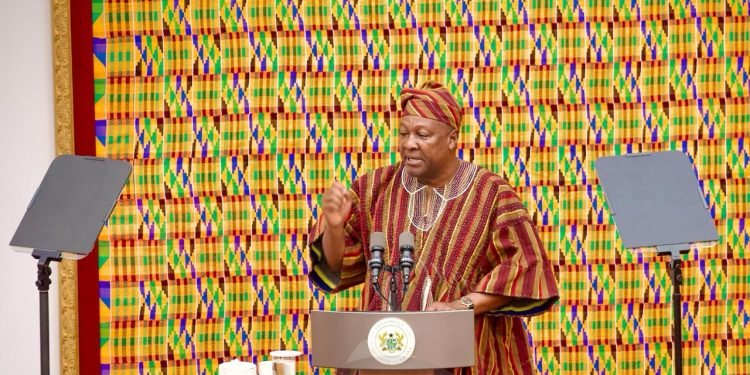
The State of Nation Address (SONA) is a political communication delivered by successive presidents as chief executive officers (CEOs) of Ghana to the Parliament and Ghanaians on the general situation of the country as well as recommends legislative programmes for the coming session of parliament, including a vision spanning economic, socio-political and technological landscape of the country’s future. Business and politics are an inter-related developmental framework within which socio-economic activities are organised to facilitate national and international trade for societal and human-wellbeing. While the politics-business dichotomy is critical in achieving sustainable national growth, expeditious justice plays a strategic role in assuring potential investors and global business captains of efficient judicial system geared at protecting investment opportunities and activities. With that framing, this post explores the judiciary’s role through the prism of the SONA, delineating Ghana’s business climate with a view to assessing president Mahama’s promise.
Judiciary in Ghana ‘s Business Environment
Judiciary plays an essential role in supporting economic and related activities of every nation in the global business space. As a developing nation, Ghana positions itself as safe economic haven with an ambition of attracting global investors as key hub in the sub-region of West Africa. That ambition can be obtained with an efficient judicial system consisting of structures to dispense quick and fair judgment to both the citizenry and business communities. Unfortunately, the current Ghanaian judicial architecture is in a quagmire manifesting inefficiency such as backlog of cases, high incidence of corruption among the judiciary and their staff, limited resources to manage caseloads as well as judicial inertia leading to wanton adjournment of cases- all conspiring to render the judicial system anti-thetical to economic growth. Equally, domestic and international investors abhor unpredictability and uncertainty that characterise the business environment; however, media reports and corruption-related issues coupled with systemic delays, frequent adjournments and poor judgments create reluctance among investors thereby dwindling opportunities of investments. Furthermore, the snarl-pace investigation, prosecution and trial of the cases of corruption perpetrated during the previous and current regimes of government affirms the long-held perception and belief among the citizenry, domestic and foreign investors that the climate is not open for business and the president’s promise remains a farce.
While the current Mahama’s regime enjoys good-will and favourable ratings among the citizenry in the areas of road construction, management of the economy and humane leadership, the brazen delay and failure in successfully prosecuting cases of financial malpractices and corruption at least of one landmark case associated with appointees of the previous government relating to pollution of water bodies and destruction of forests, consolidate the premise that Ghana’s judicial system together with the president’s promise remains a comic relief. This is because in any effective judicial system cases of high national and public interests must be prosecuted as priority. The British legal system upon which Ghana’s judicial framework was established, treat cases of corruption related to public or government agencies with urgency to reinforce confidence among the public while punishing culprits to deter others. However, under Mahama’s second regime with all the campaign promises, the Attorney-General’s Office and the Office of the Special Prosecutor are stiffly fighting over investigated documents, while the judiciary plays its game with frequent adjournments indicating firmly that they are unconcerned about the nation. In any serious and efficient government, before public announcements of public officials’ corrupt deeds or malpractices are published by the government, about seventy-five per cent of the investigation covering all vital documents, witnesses and prosecutors are selected with dedicated judges with requisite resources are provided to deal with the issues expeditiously to dispense justice to restore confidence. On that score, the litany of press conferences and excuses offered by the ministries and agencies under Mahama II are only good in dissipating investor and business communities’ confidence, thereby rendering the promise that Ghana is open for business nothing more than a farce.
Concluding Words
Ghana needs serious foreign investors to complement the domestic socio-economic initiatives to firm up growth sustainably. However, without initiative-taking, to assure the citizenry and foreign investors of expeditious prosecution and dispensation of cases, the maxim “justice delayed is justice denied” replaces “justice delayed is business denied”. And that will be injurious to the entire socioeconomic fortunes of Ghana. There is no time to entertain the maxim “the wheels of justice grind slowly”, the needs of Ghanaians require fast-paced justice else the promise that Ghana is open for business becomes a farce.