

“It takes a woman” is the title of a book written by Nana Konadu Agyeman Rawlings (Nana Konadu). While this book title connotes several interpretations – philosophical, moral, political or liberation, in the opinion of this blogpost (blog), the title reflects and symbolises freedom and empowerment that Nana Konadu bequeathed to the Ghanaian society, particularly women and children as a whole. On this sombre premise, this blog renders a tribute in honour of a woman who not only fought for women’s dignity, liberation and empowerment, but also re-engineered a socio-economic epoch that redefined, shaped and emboldened majority of Ghanaian women to assume their rightful place in contemporary Ghana.
An Enduring Emblem of Women’s Freedom
As a source of revolutionary change, Nana Konadu modelled for all Ghanaian women an image of empowerment hinged on self-assertiveness to rediscover their worth and creative talents to promote the socio-economic fabric of the marginalised in Ghana. This feat not only resonated with many Ghanaian women who were culturally confined to the lowest ebbs of society, but also extricated them from the generation-old systemic suppression branded as traditional norms. As a teenager growing up in the late 1980 and early 1990ss. this author recalls with mixed emotional feelings the numerous women and children, who were evicted from their matrimonial and family homes upon the demise of their fathers or husbands by callous family members, rendering these wives and children perennially destitutes without support. However, with a singular conviction to restore dignity and comfort to these despair families, Nana Konadu lobbied by forming alliances within and without the PNDC government for the Intestate Succession Law of 1985 (PNDC Law 111) to be enacted. The PNDC Law 111 reformed national inheritance rights to protect surviving spouses and their children while stopping greedy and covetous members of deceased husbands from molesting their widows and children. Such a liberative legal edifice not only characterises Nana Konadu as an enduring emblem of women’s freedom, but as a revolutionary agent who led Ghanaian women into the socioeconomic limelight.
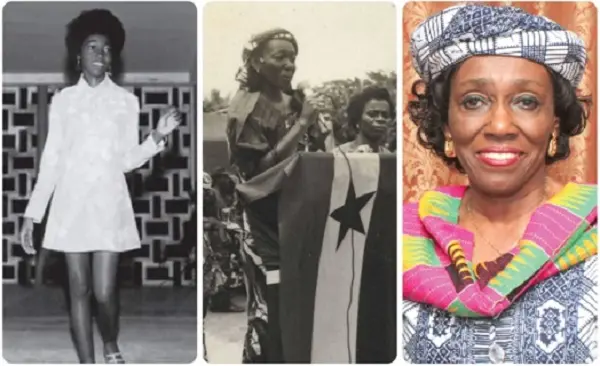
With established socioeconomic ventures throughout the regions, towns and rural communities of Ghana, Nana Konadu strategically positioned women as pillars and collaborators of men and society by engaging them in income-generative activities that made them autonomous and self-reliant with the prowess to fend for themselves and their dependents. This socioeconomic liberation emboldened many Ghanaian women, young ladies and girls to venture out into diverse trades, professions and activities otherwise designated as men’s reserve. Although the gender gap still widens in many respects of the Ghanaian society, one can say with cautious degree of confidence that “it really took a woman” and that women was Nana Konadu Agyeman Rawlings. And so, as Ghanaians mourn your demise and say farewell on 28th November 2025, this post joins in the mourning to say Rest in Eternity- Nana Konadu Agyeman-Rawlings -an emblem of Women’s Freedom.



No Comments