Introduction:
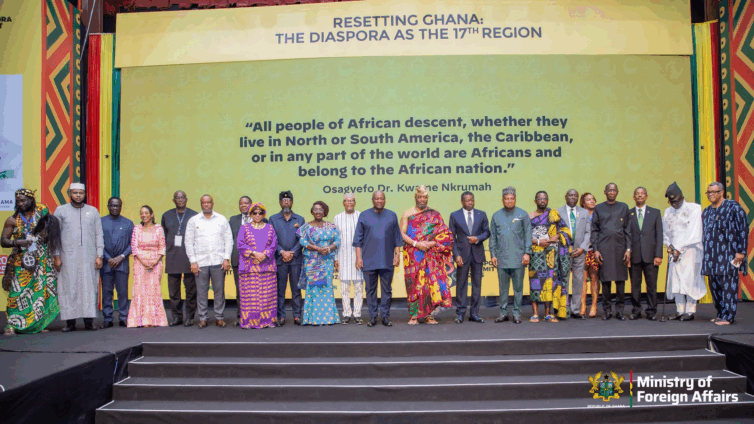
Between 19-20 December 2025, Ghana hosted an international conference (Conference) under the theme “Resetting Ghana: The Diaspora as the 17th Region” with an objective to deliberate on strategies and policies to promote Ghana’s cultural richness to the diasporan community as well as share approaches to develop the common good of the participating partes. Also, one key topic which ran throughout the conference was the reparation/compensation agenda to restore dignity for Africans and peoples of diaspora, for suffering atrocious slave trade and slavery-related crimes. Furthermore, the Conference sought to explore strategic partnership with the diasporan community to exchange ideas and develop sociocultural projects, which will create employment and economic opportunities to enhance the mutual benefits to the participants. Moreover, some African heads of states, including seasoned journalists, as well as President John Mahama, have been propagating the reparation “gospel” at international fora to in an attempt to secure compensation for Africans who suffered the ills of slavery and slave-trade vices. While the issue of reparation has attracted mixed debates from academia, politicians, diplomats and the general society, this post holds the view that Ghana, African states and the diasporan community should focus on devising and implementing strategic policies and programmes that will wean them from dependence on the US, Europe and other external powers, thereby gaining international recognition and substantive freedom. This post is not against the concept of reparation for Africans; however, the obsession of prominent African politicians in chasing after this futile policy at international fora, dwindles the opportunity of strategically repositioning the region to global recognition. Against that background, this post, first, explores the issue of reparation in light of contemporary geo-political dynamics; second, the need to develop domestic and regional competencies to become self-sufficient with little or no dependence on external help; and third, to build a regional political structure that promotes and projects Africa as a continent capable of fending for its peoples freely.
Reparation in times of rupturing International Order
The demand for reparation for slavery and slave-trade crimes committed by the western states against Africans and people of the diasporan community continue to induce mixed opinions an argument among academia, politicians and diplomats, suggesting that the demand is not only difficult to achieve but also embody legal complexities that will expend huge state resources and time to achieve. Besides the legal and financial capabilities required to pursue this agenda, the fluid nature of international politics and geopolitical tensions playing out between the US and Europe regarding the Greenland debacle, the US-Europe engagement in Ukraine against Russia, coupled with the simmering tension between Iran- Isreal in the middle-east, who has the time and space to consider reparation for slavery committed against Africans. While this reparation argument has persisted for many years without meaningful progress, the lesson for Ghana, Africa and the diasporan community is to re-orient strategically by directing their energies and limited resources to create domestic and regional capabilities which will help in transforming the worth and status of their peoples to attain global respect. Until that feat is achieved and a new regional brand is established, the reparation agenda by Africa will remain an illusory project. One will find semblances of such national and regional strategic re-orientation in Mark Carney’s speech at Davos and his recent trip to negotiate trade and partnership agreements with China for mutual benefits of both countries. The time to build domestic and regional socioeconomic fortress in Africa should be the driving agenda and not reparation.
Building National and Regional Competencies in place of Reparation
President Mahama of Ghana delivered a speech at the just ended Davos conference in Switzerland, stating that Africa, including Ghana, owned the world’s largest natural resources yet benefit very little from their value-chain benefits from the west (this is just a paraphrase of the statement). That statement by President Mahama must serve as a clarion call to awaken him and his colleagues, heads of states, to initiate bold, serious and sustainable socioeconomic programmes to wean Africans from depending on foreign powers and their expertise. Ghana has the University of Mines, Kwame Nkrumah University (KNUST), University of Ghana (Legon), University of Cape-Coast (Capvas) among many others; however, recently a mineral lease was being offered to an Australian Company cheaply to explore that resource in Ghana. But for public protestation, the concession would have been signed with the foreign multinational company (MNC). On that score, Is it any wonder that Ghana and many African states continue to struggle socioeconomically without adopting novel strategies to process their minerals regionally? Why is it that these Ghanaian and other African universities are not offered opportunities to process or champion national and regional developmental programmes? These universities have been established over decades and produce graduates upon graduates every year; however, they are not involved in any substantive national developmental projects as transpire in western countries; so why won’t you be given the scraps of your natural resources? To regain substantive national and regional sovereignty, the focus must be directed to develop local expertise because that is what China did from the 1970s for which reason it has become a globally recognised super economic state with political and military influence and still growing in influence. At the cusp of declining US’ global dominance, Ghana, and for that matter Africa, must look to build regional capability to promote continental independence anchored in sustainable socioeconomic and political freedom.
Establishing Africa’s Political & Economic Capability
This post is not oblivious to the fact that building a potent regional political architecture imbued with power to direct and extricate the region and its constituent states from external powers is a herculean task. However, this feat has been achieved by other regional entities, especially in Asia. Still at Davos, Mark Carney remarked that “In the world of great power rivalry the countries that lie between need to find a new way of doing things to survive.” Although Carney was reflecting on the tumultuous, erratic and weaponisation of Trump’s tariffs and the counter-measures being implemented by Europe and China- which have the capacity of distorting the Canadian economy, he acted swiftly with creative thinking of establishing relationship with China. That strategic ploy should guide Africa and its member states to form regional alliances to expedite growth. Africa needs dedicated and selfless leaders within each member state to show patriotism, compassionate and honesty in fomenting and implementing regional socioeconomic policies that will promote human decency while collaborating with one another strategically to reposition the continent. With home to many natural and precious mineral resources in the world, coupled with good cultivable agricultural lands, the African region and its diverse peoples require altruistic leadership to steer the affairs of the continent innovatively. While few individual African leaders are making frantic effort to build their domestic fronts socioeconomically, that individual effort alone will not register the region-wide impact and cohesive growth and stability to translate it into a regional powerhouse without external dependence.
Concluding Remarks
This post holds the view that the reparation “gospel” being preached by African presidents, especially John Mahama in recent times, Journalists as well as leaders of the diasporan communities, resembles comic relief performances. The obsession with the reparation “gospel” by African leadership and some individual presidents without strategically looking inwardly for sustainable solutions to address pressing problems across the region will ordain the region as perennial dependents of US, Europe and other developed states. While the African continent has the richest mineral and natural resources in the word, its perennial underdeveloped status spanning socioeconomics, politics, educational and cultural paralysis, hinged on its failure to carve out domestic expertise to propel the continent out of depravity. Shelving the reparation “gospel” will incentivise as well as drive African leadership to pursue home-grown and regionally oriented solutions to offer them deserving respect in the global space, while the reparation agenda will only succeed in characterising them as comic relief performers. The choice is before the region/state.